
Weights
When fishing certain situations, a weight is needed to get the bait down, keep it in one spot, or slow the bait down through a current. There are a variety of weights available for almost every type of fishing. Almost all weights are made from lead, but some are now available in brass and other metals due to environmental considerations. Weights or sinkers range in weight from 1/32 ounce to 1/2 ounce or better.
 Split Shot
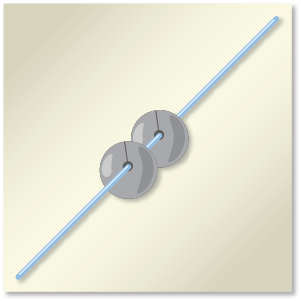
The split shot is probably the most popular of all weights. Almost every angler has them in their tackle boxes, or on the floor of their boats. Resembling a shot form a shotgun, the split shot weight has a slit down one side. The slit allows the shot to be crimped anywhere on the line. This type of weight is used mostly when fishing for crappie or bluegill to weight down minnows, worms, or crickets. Simply find a desired location for the weight and crimp it on the line. Be sure to use pliers when crimping though, it’s a lot cheaper than a trip to the dentist.
 Bell Sinker
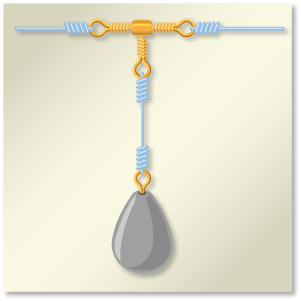
Resembling a bell shape, the bell sinker is used when one or more lines are attached to the main fishing line, or when making a drag rig. Usually ranging in weight from 1/8 ounce to 1 ounce, the bell sinker works well when trying to keep the bait off the bottom when still fishing or moving along a current.
 Barrel Weight
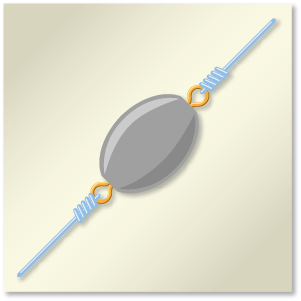
Similar to bell sinkers, barrel sinkers has eyes at both ends. As with the bell sinker, single or multiple lines can be used. In most cases, the barrel sinker is used with a single line that’s cut to a determined length to keep the bait off the bottom. The added line also allows the fish to take the bait before feeling the weight. This is a great advantage to the angler. The rounded edges of the barrel sinker helps to keep the sinker from snagging on rocks or in crevices. The weight ranges of the barrel sinker are from 1/4 ounce to 8 ounces.
 Bullet Weight
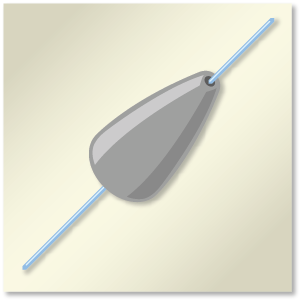
Also known as slip sinkers, the bullet weight is used mostly when fishing with plastic worms. Ranging in weights from 1/16 ounce to 1 ounce, the bullet weight can move freely along the fishing line. When rigging, the line is passed through the weight, then tied to the hook. While on the bottom, the fish can take the worm without feeling the weight, giving the fisherman time for the hook set. The cone shape of the weight allows it to pass through vegetation, trees, and rocks. To keep the worm and weight from hanging over trees, the bullet weight is sometimes pegged to the line with a toothpick. Glass beads are also added at times between the weight and the worm to add sound when working the worm.